Lung Nodule Growth Rate Calculator . Latent tuberculosis (tb) oxygen guidelines. Medical calculators, criteria sets and decision trees. The Radiology Assistant BTS guideline for pulmonary nodules from radiologyassistant.nl A total of 15 malignant and 19 benign characteristics were identified. This calculator uses the modified schwartz formula:. The cad can automatically classify and quantify nodules and calculate nodule growth rate in a cohort of a routine clinical population.
Calculate Potential Energy Between Two Charges. Q1 = charge of object 1. Just to a caveat to the question based on milan joshi’s answer.
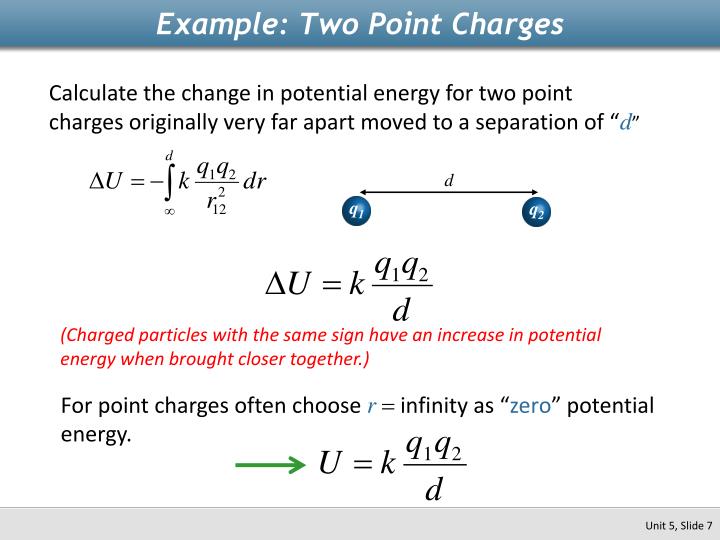
PPT Physics 2112 Unit 5 Electric Potential Energy PowerPoint from www.slideserve.com
F is the electrostatic force between charges , q₁ is the magnitude of the first charge (in coulombs), q₂ is the magnitude of the second charge (in coulombs), r is the shortest distance between the charges (in m), k e is the coulomb's constant. Since the square is of side a = 2. The electric potential energy of a system of three point charges (see figure 26.1) can be calculated in a similar manner.
U = Q2V2 = K Q 1Q2 R 12 #1Belectric Potential When Q2 Is Placed:
W = 1 4π × ϵ × ϵ 0 × q × q 0 r. F is the electrostatic force between charges , q₁ is the magnitude of the first charge (in coulombs), q₂ is the magnitude of the second charge (in coulombs), r is the shortest distance between the charges (in m), k e is the coulomb's constant. The problem with talking about charges is that there are a lot of places in physics where “charges” are.
This Is Similar To The Formula Gpe = M × G × H Which Is True Only When The Object Is Inside A Uniform Gravitational Field (Near The Earth Surface For Example).
The formula epe = q × e × d is true only in some specific cases, when the electric field is uniform (for example between two oppositely charged parallel plates). It is equal to 8.98755 × 10⁹ n·m²/c². W = 1 (4 × ) × × × ×.
The Potential Energy Of The Charge Q In The Field Is Equal To The Work Done In Bringing The Charge From Infinity To The Point.
Plug values for charge 1 into the equation {eq}v=\frac {kq} {r} {/eq} step 3. Q2 = charge of object 2. #1aelectric potential when q 1 is placed:
U = 0 If R = ∞.
Now, we know that the potential at infinity is always taken to be zero; Q1 = charge of object 1. Potential energy of the system is.
This Is A Testament To The Similarities Between The Two Concepts As Well As The Ease Of Adapting A Geogebra Applet For Education.
Find the potential difference between the two plates. = v 1 = k q2 r 12 electric potential energy when q 1 is. That depends how near ground it is.


Comments
Post a Comment